Corporate gifts can do more than just thank employees, clients and business partners. When they are selected well, they turn into reminders of what a company stands for. The right gift can show professionalism, creativity, reliability, sustainability or genuine appreciation without needing a sales pitch. Still , choosing an appropriate item is not only about picking something nice from a catalogue. Businesses should look at brand identity, the recipient, the occasion, usefulness, quality, budget, and presentation before they place an order.
Corporate gifting should therefore be treated as an extension of your brand experience. A technology company might lean toward useful desk accessories, while a luxury consultancy could prefer refined stationery. The goal is not to make everything identical, but to make sure the gift feels aligned with the character your business wants people to carry in their memory.
Brand-aligned Corporate Gifting
Brand aligned corporate gifting creates a stronger link between your values and the recipient’s everyday experience. Before you choose corporate gifts, ask what the item really says about your company. A useful, well-finished piece can reinforce professionalism, inventiveness, reliability or appreciation.
Start With Your Brand Personality
Before exploring corporate gift ideas, define the personality you want to communicate. Think about whether your brand is modern, traditional , playful, premium, practical, sustainable or professional. Then translate those traits into product characteristics that the recipient will notice.
A modern brand might pick technology accessories, sleek drinkware, or minimalist desk products. A traditional financial firm may prefer classic diaries, pens, or carefully presented gift sets. A creative agency could choose unusual utility products that encourage conversation. The important point is consistency. The product, colour, packaging, message and customization should support the same identity.
Match Gifts With Your Brand Values
Brand values can provide a useful filter when comparing products. If sustainability is central to your positioning, consider reusable products, responsible materials and packaging that avoids unnecessary waste. If employee wellbeing is important, useful lifestyle products may communicate that commitment more effectively than decorative merchandise.
Companies that value learning can consider notebooks, planners or thoughtful desk accessories. Organisations focused on performance may use recognition awards or premium business gifts for milestones. Its design and usefulness make the message feel natural.
Think About the Recipient First
A brand-focused approach should never ignore the person receiving the gift. Corporate giftsfor employees may need to fit different roles, ages ,preferences and working environments. A product that works well for an office-based team may be less useful for employees who travel frequently or work remotely.
Corporate giftsfor clients require another layer of consideration. Clients may have different professional cultures, expectations and levels of familiarity with your company. Choose items that feel respectful and useful without becoming overly personal. The best gifts show consideration rather than simply distributing promotional merchandise.
Separate Employee and Client Gifting
One universal gift may simplify procurement, but it is not always the strongest strategy. Employees and clients often have different relationships with your brand. Employees contribute directly to the organisation, while clients and partners experience the business from an external perspective.
For employees, gifts can support recognition, celebrations, onboarding or appreciation. For clients, the purpose may be relationship building, gratitude or milestone recognition. Separate categories can make corporate gifting more relevant while preserving a consistent brand identity.
Choose Utility Over Novelty
Novelty can attract attention, but usefulness often creates longer-lasting value. A recipient is more likely to remember a company when its gift becomes part of their routine. Think about objects that people can use at work, during travel, at home, or during everyday activities.
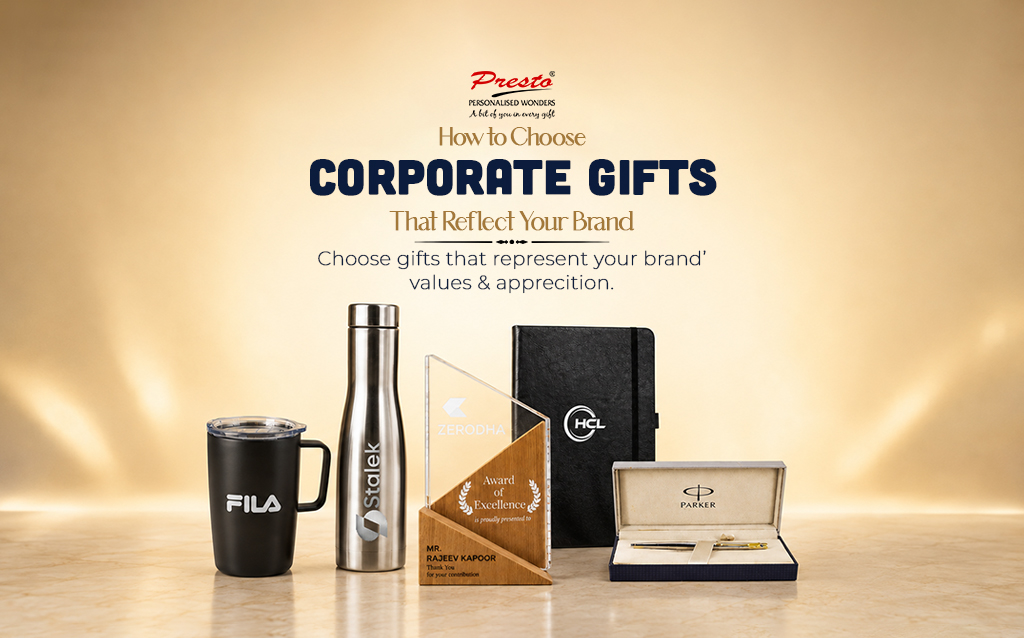
Presto’s corporate collection includes categories such as drinkware and utility gifts, office stationery, apparel and bags, trophies and certificates and joining kits. This range can help businesses compare practical options according to different gifting objectives.
Use Branding With Restraint
Brandedcorporate gifts should help the organisation look recognizable, but without turning the recipient into some sort of walking advertisement or moving billboard. If you add too many logos, use oversized graphics, or choose really loud colours, then even an otherwise good product can start to feel less premium or lower-quality.
Use your logo in a way that matches the product’s design. A small engraving, subtle printing, or a tasteful placement can come across as genuinely professional. You might also include a short message or the recipient’s name, when it actually fits. The idea is simple: make the brand visible, while the product stays practical, useful, and still attractive.
Consider Personalization, careful
When corporate gifts are personalized they often end up feeling more like someone actually paid attention, even if it's just a name or a tiny note. Because, it does acknowledge the person who receives it. Adding a name, job title designation, achievement date, or even a brief message can make a plain item feel more meaningful.
For an employee recognition gift their name plus the achievement date can work really well, but for a client gift you might rather use the company name, with a subtle personal note. Just try not to add details that could feel intrusive, or otherwise unnecessary. Well-done personal touches bring relevance not clutter , and they should feel natural.
Select Products That Match the Occasion
The same product won’t fit every business moment. Joining kits should help new employees feel welcomed and prepared. Recognition gifts should communicate achievement. Festival gifts usually feel warmer, more celebratory, while conference giveaways often need to be compact, and easy to carry.
Corporate giftingideas get way more effective when the occasion decides the purpose of the product. For example, a premium diary can work for an annual leadership meeting, while a practical bottle, or maybe a tech accessory could fit nicely for an employee engagement campaign.
Set a Realistic Budget
Budget affects product quality, customization, packaging, the amount you order, and delivery logistics too. Instead of choosing anything first and fixing later, it’s smarter to set spending tiers based on recipient groups, and the occasion in particular.
You could form an everyday appreciation tier, a milestone tier, and a premium client, or leadership tier. That way businesses manage costs without making every gift feel exactly the same, and even with different options the overall look still feels coordinated ,not randomly thrown together. When you place a bulk corporate gift order, also ask about minimum quantities, customization fees, packaging formats, delivery times and replacement policies before you fully confirm the purchase.
Evaluate Quality Before Quantity
A large gift order only truly matters when the items actually match the expected standard. If finishing is poor, materials are flimsy, printing is off, or personalization is inconsistent, recipients will notice, and they’ll quietly connect it to the company behind the gift.
Request samples whenever possible. Compare dimensions, check materials, review the print or engraving quality, and look at packaging and presentation. If the products are meant to form a set, see whether they look like a matched group, not like separate extras. Quality control is especially necessary for customized corporate gifts because mistakes can become costly once production is already underway.
Make Packaging Part of the Brand Experience
Packaging shapes the first impression, and it can also support the company’s visual identity. A carefully arranged box, a branded sleeve, a short but thoughtful note or even clean wrapping, can make a practical item feel much more meaningful.
A premium brand might do better with refined materials and a restrained layout rather than heavy decoration, and too much “sparkle” for the sake of it. Packaging should feel like an extension of the product.
Create Consistency Across Different Gifts
Businesses often need different products throughout the year. Consistency does not mean buying the same item repeatedly. Instead, establish simple brand rules for colour,logo,placement, typography,packaging and messaging.
These standards help diaries, bottles, trophies, bags or hampers feel connected to the same organisation. They also make procurement easier. A consistent system can be especially useful when several departments order gifts independently.
Think About Practical Logistics
An attractive product can become a poor choice if it is difficult to deliver or customize at scale. Before selecting an item, consider shipping size, recipient locations, production time, storage requirements and packaging durability.
For nationwide or multi-location programs, confirm whether the supplier can maintain consistent customization and fulfillment. Presto states that its corporate offering supports employee gifts, client and partner gifting, joining kits, event giveaways and bulk gifting programs, which can be relevant for businesses managing varied requirements.
Choose Customization That Serves a Purpose
Customized corporate gifts should solve a communication need rather than exist simply. A logo can strengthen recognition. A recipient’s name can create personal connection. A message can explain the reason for the gesture. An achievement detail can turn a generic award into a meaningful recognition piece.
Before approving artwork, check logo resolution, spelling,colours, dimensions and placement. Ask for a digital proof if the supplier provides one. Small errors can become highly visible when multiplied across a large order.
Build Different Gifting Tiers
Not every recipient needs the same value or product. Creating tiers can help businesses maintain fairness and purpose. Employees may receive standard appreciation gifts, while long-term clients or strategic partners receive more elevated options.
Premiumcorporate gifts can be reserved for major milestones, executive relationships, or high-value events. Each tier should offer appropriate quality and usefulness while reflecting the same brand standards.
Measure What Works
Corporate gifting does not need to rely entirely on intuition. After a campaign, collect feedback. Ask employees which products they used and preferred. For clients, relationship managers can record responses and engagement.
These observations can create a simple internal gifting guide. Track occasion, recipient type, product category, budget,personalization method and feedback. This makes future selection faster and helps avoid repeating unsuccessful choices.
Explore a Curated Corporate Gifting Range
When the strategy is clear, businesses can compare products that fit their audience, budget and brand personality. Presto offers corporate categories covering branded pens, bottles, diaries, keychains, mugs, tumblers, T-shirts, utility gifts, backpacks, caps,trophies, awards and other options. Its catalogue also includes price-based corporate gift categories, including options under different budget levels and premium selections.
Conclusion
The best corporate gifts are not necessarily the most expensive or unusual. They are the ones that connect brand identity with recipient needs in a thoughtful, practical way. Start with your values, define the message, understand the audience,select useful products and apply branding with restraint.
From employee appreciation to client relationships, a structured approach can turn business gifts into meaningful brand touchpoints. Personalized gifts for clients can strengthen individual relationships while useful gifts for teams can support recognition and belonging.